Chapter 5
Ayurvedic Lifestyle: The Ultimate Preventive Medicine
How you live your daily life is the key factor in determining your health and your quality of experience. It is also the factor over which you have the most control. You can’t control the weather or your genetic makeup, but what you do every day either builds up your health, vitality, and resistance to disease, or wears you down. Your moment-to-moment choices—what to eat, how much to eat, how to respond to others, whether to exercise or not, how late to stay up at night, and so on—play a major role in your mental and physical health.
But how do you create your lifestyle, the rhythms of your daily living? Is it just pure habit, based on how your parents lived and how you grew up? Should the time you wake up be dictated by when you need to get to work, and should what you eat be determined by what’s available at the fast-food shops? If you decide to take control of your lifestyle and structure new, healthier habits, what principles will guide you?
According to Ayurveda, you couldn’t do better than to strive to live your life in harmony with Mother Nature.
In Tune with Nature
Ayurveda flourished in a civilization vastly different from life today, a world in which human life was intimately intertwined with the life of nature. The great rhythms and forces of nature—the alternation of day and night, the rhythmic cycle of seasons—all affect us, as do the inevitable seasons and cycles of human life, birth and growth, aging and death. Through the plants we eat for food, the water we drink, and the air we breathe in common with all beings, we are inextricably one with nature.
The sages of settled mind who unfolded the wisdom of Ayurveda saw this, and they saw that the master key to good health is to get ourselves into harmony with nature. Thus the ideal Ayurvedic daily routine that follows is, as you will see, based on patterns of nature.
Being in tune with nature also means being in tune with your nature, your constitution or prakruti (which means nature). It means being true to your own nature, to how you are built, mentally and emotionally as well as physically. It means that your food and exercise requirements, how much you need to sleep, how much sexual activity is healthy for you, what kind of climate is beneficial, all revolve around your doshic makeup, your individual nature.
Living in accordance with nature and natural law means continually balancing our inner ecology by adjusting to our ever-changing environment.
Ayurvedic Daily Routine
A daily routine is essential for maintaining good health and for transforming our body, mind, and consciousness to a higher level of functioning. A regulated daily routine puts us in harmony with nature’s rhythms. It establishes balance in our constitution and helps to regularize our biological clock. It indirectly aids in digestion, absorption, and assimilation of food, and it generates self-esteem, discipline, peace, happiness, and long life.
Waking up too early or too late, undisciplined eating, staying up too late, job stress, and untimely bowel movements are a few habits that can unsettle us. Regularity in sleeping, waking, eating, and eliminating, indeed following a regular daily routine, brings discipline to life and helps maintain the integrity of the doshas.
Our body is a clock. Or rather, it is several clocks at once. According to Ayurveda, every organ has a definite time of maximum functioning. Morning time is the lung time. Midday is stomach time, when we feel hungry. Afternoon is liver time, and late afternoon is when the colon and kidneys operate at their peak.
This biological clock works in conjunction with the doshic clock. Morning and evening (dawn and dusk) are the times when the influence of vata is greatest. In the early morning, from about 2 A.M. to sunrise, vata creates movement and people awaken and tend to excrete waste. Again in the late afternoon, from about 2 P.M. until sunset, the influence of vata makes one feel light and active.
Early morning and evening are kapha times. From sunrise until about 10 A.M., kapha makes one feel fresh but a little heavy. Then again in the evening, from about 6 P.M. until around 10, kapha ushers in a period of cooling air, inertia, and declining energy.
Midday and midnight are pitta times. At midmorning, kapha slowly merges into pitta, and by noon one feels hungry and ready for lunch. Again from 10 P.M. until around 2 A.M., pitta is at its peak, and food is digested.
Thus there is a daily cycle of vata–pitta–kapha:
6 A.M.–10 A.M. = kapha
10 A.M.–2 P.M. = pitta
2 P.M.–6 P.M. = vata
6 P.M.–10 P.M. = kapha
10 P.M.–2 A.M. = pitta
2 A.M.–6 A.M. = vata
So there is a doshic clock (when a particular dosha is operating at its peak) and a biological clock (when a particular organ is operating at its peak). Based on these clocks, the Ayurvedic sages developed the dinacharya, or daily routine. This daily routine is the art of bringing harmony between the biological and doshic clocks and chronological time. Here are its most salient features:
WAKE UP EARLY
It is beneficial to wake up before the sun rises. At this time of the morning, pure qualities are lively in nature, which can bring freshness to the doors of perception and peace of mind.
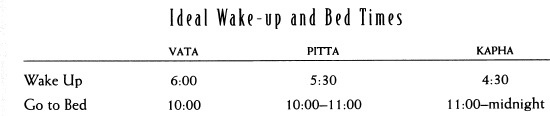
Ideally, vata people should get up at about 6 A.M., pitta people by 5:30, and kapha people by 4:30. This is the ideal: do the best you can. If you can wake up at 5:30, it will be very good.
Right after awakening, look at your hands for a few moments, then gently move them over your face, neck, and chest down to your waist.
This will bring more alertness.
SAY A PRAYER
It is good to start the day by remembering the Divine Reality that is our life. You may do this in your own way, as your religion or personal experience dictates. Or you may use this simple prayer:
Dear God, you are inside of me
Within my very breath
Within each bird, each mighty mountain. Your sweet touch reaches everything
and I am well protected.
Thank you God
for this beautiful day before me.
May joy, love, peace, and compassion be part of my life
and all those around me on this day.
I am healing and I am healed.
WASH YOUR FACE, MOUTH, AND EYES
Splash your face with cold water a couple of times. Swish and rinse out your mouth. Then wash your eyes with cool water, and massage the eyelids by gently rubbing them. Blink your eyes seven times, and then rotate your eyes in all directions: side to side, up and down, diagonally, clockwise, and counterclockwise. All this will help you feel alert and fresh. (See “Eyes—Ayurvedic Care” in Part III for more on eye exercises and eye washes.)
DRINK A GLASS OF WATER
Drink a glass of room-temperature water, preferably from a pure copper cup or tumbler. (Fill the cup the night before and let it sit overnight.) If the water is too cold, it may provoke kapha disorders such as colds, coughs, and sore throat. For kapha and vata individuals, it is actually better to drink hot water, but for a pitta person, lukewarm is best.
This water will not be absorbed but will wash the gastrointestinal tract and flush the kidneys. It also stimulates peristalsis in the intestines, stimulates the descending colon and ileocecal valve, and helps with having a good bowel movement.
It is not a good idea to start the day with coffee or black tea. These drain kidney energy, overstimulate the adrenals, and promote constipation. They are also habit-forming.
EVACUATION
Sit (or better, squat) on the toilet, and have a bowel movement. Even if you don’t have the urge, sit for a few minutes, without forcing. If you do this every day, following your glass of warm water, the habit will develop. (See “Constipation” for suggestions on promoting healthy bowel movements.)
After evacuation, wash the anal orifice with warm water, then wash your hands with a gentle soap.
CLEAN YOUR TEETH AND TONGUE
Use a soft toothbrush for your teeth, and an herbal powder made of astringent, pungent, and bitter herbs. (See “Teeth and Gums—Ayurvedic Care” for further suggestions.)
Scrape your tongue every morning. This is an important part of daily hygiene, from which you can learn a lot about your health and habits. Note how coated your tongue is, and how your breath smells. If you get the smell of last night’s pizza, that means the food is not yet thoroughly digested. If there is a lot of coating on the tongue, that means there is much ama or toxicity in the system. Perhaps you ate too late, or your dinner was hard to digest.
If there is ama on the tongue and a bad smell on the breath, don’t eat breakfast. Eating breakfast is not good if you have not digested last night’s dinner.
You can see that this daily regimen brings more awareness. By
following this routine, you come in contact with your body and observe the functioning of your system. You know exactly what is happening. This knowledge gives you the power to create better health by altering your behavior.
To scrape your tongue, use a stainless-steel tongue scraper. You can also use a spoon. Gently scrape from the back or base of the tongue forward, until you have scraped the whole surface (seven to fourteen strokes). In addition to removing bacteria from the tongue, scraping sends an indirect message to all the internal organs and stimulates gastric fire and digestive enzymes.
GARGLE
To strengthen the teeth, gums, and jaw, to improve the voice and remove wrinkles from the cheeks, gargle twice a day with warm sesame oil. Also, hold the oil in your mouth and swish it around vigorously. Then spit it out and gently massage the gums with your index finger.
NOSE DROPS (NASYA)
Now put 3 to 5 drops of warm ghee, brahmi ghee, or sesame oil into each nostril. This helps to clean the sinuses and also improves voice, vision, and mental clarity. In dry climates, and during cold winters when the house is heated with dry air, nose drops help to keep the nostrils lubricated. (For more on nasya, see appendix 3.)
The nose is the doorway to the brain. Use of nose drops nourishes prana and enlivens consciousness and intelligence.
OIL MASSAGE
Take 4 or 5 ounces of warm (not hot) oil, and rub it all over your head and body. Gently massaging the scalp with oil can bring happiness into your day, as well as help prevent headaches and slow balding and graying of your hair. If you oil your body again before going to bed, it will help induce sound sleep.
Oil massage improves circulation, calms the mind, and reduces excess vata. The skin of the entire body becomes soft, smooth, and brightened.
Best Oils by Body Type
For Ayurvedic oil massage, use one of the following oils, according to your constitutional type:
Vata = sesame oil
Pitta = sunflower oil
Kapha = corn oil
BATHING
Following your oil massage, take a bath or shower. Bathing is cleansing and refreshing. It removes fatigue, brings energy and alertness, and promotes long life. Bathing every day brings holiness into your life.
EXERCISE
Everyone should do some exercise every day. A walk in the fresh early-morning air and some yoga stretching are good enough for many people; some additional aerobic exercise may also be beneficial, depending on your prakruti.
Kapha individuals, with their stronger, heavier physiques, can do the most strenuous exercise, and they benefit from it. Jogging, bicycling, tennis, aerobics, hiking, and mountain climbing are great for kaphas (though they don’t like such vigorous exercise!). Pittas do well with a moderate amount (swimming is especially helpful for cooling pitta), while vata individuals do best with quieter exercises like walking, easy swimming, or yoga asanas.
As a general rule, Ayurveda recommends exercising up to one half of
one’s capacity. A good gauge is to exercise until sweat forms on the forehead, under the arms, and along the spinal column. Straining is absolutely not recommended.
Yoga stretching is recommended for all body types. Postures particularly beneficial for vata individuals include the Sun Salutation (twelve cycles, done slowly). The most important seat of vata in the body is in the pelvic cavity, and any exercise that stretches the pelvic muscles helps to calm vata. These include the Forward Bend, Backward Bend, Spinal Twist, Shoulder Stand, Plow, Camel, Cobra, Locust, Cat, and Cow poses, and Leg Lifts. The Headstand, Half Wheel, and Yoga Mudra are also beneficial. (For illustrations of yoga postures see appendix 4.)
The major seat of pitta is the solar plexus, so exercises that stretch the muscles around the solar plexus are especially beneficial for individuals with a pitta prakruti and will help to pacify pitta. These include the Fish, Boat, Camel, Locust, and Bow poses. Pittas should also do the Moon Salutation (sixteen cycles, moderately fast). Avoid the Headstand, Shoulder Stand, Plow, and other inverted poses.
The important seat of kapha is in the chest. Exercises that stretch the pulmonary cavity and increase circulation in the chest are effective for kaphas and will help relieve and prevent bronchial congestion, cough, and other kapha illnesses. Beneficial postures include the Sun Salutation (twelve cycles, done rapidly) and the Shoulder Stand, Plow, Locust, Bridge, Peacock, Palm Tree, and Lion postures. (Illustrations of yoga postures are found in appendix 4.)
PRANAYAMA
After finishing your exercises, sit quietly and do some deep breathing: twelve Alternate Nostril breaths for vata; sixteen Cooling (shitali) breaths for pitta; one hundred Breath of Fire (bhastrika) breaths for kapha. (Instructions for these breathing exercises appear in chapter 6.)
MEDITATION
End your pranayama by going right into your meditation. Whatever system or technique of meditation you do, do it now. If you don’t presently do any meditation practice, try the Empty Bowl meditation explained in chapter 7. You will find that meditation brings peace and balance into your life.
BREAKFAST
Now it is time for you to enjoy your breakfast! Your meal should be fairly light in the hot months, and more substantial in cold weather. Vata and pitta persons should eat some breakfast; kaphas are usually better off if they don’t eat, since eating during kapha time will increase kapha in the body. Follow the dietary guidelines for the three doshas which appear in chapter 8.
OFF TO WORK
After breakfast go to work or to your studies if you are a student. While walking to work (or to and from your car, the train, or the bus), be aware of every step. Carry your meditative mind with you. When you look at your boss or colleague, at the same time look inside. Then your work will become a meditation. You will find yourself looking at others with compassion and greater awareness.
It is better not to drink tea or coffee at work. If you are thirsty, have some warm water or some fruit juice if you prefer.
LUNCHTIME
By around noon you will become quite hungry. Have a bowl of soup and some salad, or some rice and vegetables, following the guidelines for your constitution. And don’t drink too much during your meal. Take a cup of water (preferably warm but definitely not iced), and just take a sip between two mouthfuls of food. Drinking a little water improves digestion.
One can drink a cup of water an hour before lunch or an hour after lunch, but not immediately afterward, as that slows down digestion and creates ama.
SIT STRAIGHT, WALK STRAIGHT
Maintain your vertebral column straight. When you keep the backbone straight, energy flows upward and you maintain your awareness. It is difficult to be aware when the spine is crunched.
TAKE A WALK
When you’ve finished your job for the day, go home and take a walk, alone, silently, in the woods, in the park, or on the bank of the river. Listen to the water, the birds, the rustle of leaves, the barking of a dog. In that listening, the meditative mind is regained.
In this way, every day becomes heavenly. Every day becomes a celebration, something new. That’s why the routine is most important. The discipline of the routine leaves room for awareness, openness, and freshness.
SUPPER TIME
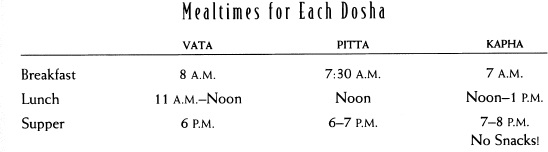
At around six o’clock (see “Mealtimes for Each Dosha” box) have your supper. If you like to cook, you can cook according to the Ayurvedic Cookbook for Self-Healing that I have written with my wife, Usha Lad (see the Reading List). Don’t watch television while eating. Pay attention to the food. Eating food with attention becomes meditation. And when you are eating with awareness, you will not eat too much; you’ll eat just a sufficient amount.
It is better to eat when the sun is up. Eating late at night will change the body chemistry, sleep will be disturbed, and you will not feel rested in the morning. If you eat supper around 6, by 9 the stomach will be empty and you will sleep soundly.
AFTER DINNER
Sing songs while you wash the dishes. Be happy. Keep smiling.
About an hour after dinner, if you are taking triphala (an herbal compound that is both strengthening and purifying), take ½ teaspoon with some warm water.
Then if you like, you can watch TV, perhaps some news. You should know what’s happening in this world of ours. Or you can read a magazine or a book.
BEFORE GOING TO BED
Before you go to bed, some spiritual reading is important, even if only for a few minutes.
And don’t forget to drink a cup of hot milk, with a little ginger, cardamom, and turmeric. Drinking milk at bedtime helps to induce sound sleep. According to Ayurveda, that milk also nourishes shukra dhatu, the body’s highly refined reproductive tissue.
Rubbing a little oil on the soles of your feet and on the scalp is also soothing and promotes restful sleep.
Finally, before you go to bed, do a few minutes of meditation. Sit quietly and watch your breath. In the pauses between breaths, you’ll meet with nothingness, and nothingness is energy and intelligence. Allow that intelligence to deal with your problems. In this way, you’ll begin and end your day with meditation, and meditation will stay with you even during deep sleep.
BEDTIME
It is recommended that vatas go to bed by 10 P.M. and sleep on their left side. Pittas should sleep on the right side, retiring between 10 and 11 P.M. The best bedtime for kapha individuals is between 11 and midnight; they should sleep on their left side.
Kapha individuals generally like to sleep about nine hours, and they feel it is good for them. But this is an illusion. Sleeping this long will slow down their metabolism, and they will put on weight and become chubby. The best schedule for them is to stay up until about 11 P.M. or midnight, then to wake up early, around 4:30 or 5:00 A.M. and go out for a walk. That shorter sleep will help to induce a light quality in their body, and they will start losing weight.
SEX
Ayurveda has some definite suggestions about the proper role of sex in our lives. Sex is a tremendous creative force, and through sex people share their love and compassion and can derive great pleasure.
Sex is also correlated with constitutional type. The recommended frequency of sexual activity is quite different for the different types. Kaphas, with their strong constitutions, can make love two to three times a week, whereas the suggestion for vatas is once or at most twice a month. Pitta individuals are in the middle; every two weeks is recommended for them.
Too-frequent lovemaking reduces ojas, the body’s vital energy, and leaves the person weak and open to diseases. It also aggravates vata dosha.
To restore strength and replenish ojas, after each time you make love a massage is helpful, as are nourishing drinks such as almond milk. (See recipe for almond milk on this page.) The best time for lovemaking is between 10 and 11 P.M. Sex in the morning or in the daytime is not recommended.
This entire daily routine is very important.
I set more store by a good regimen that maintains my humors in balance and procures me a sound sleep. Drink hot when it freezes, drink cool in the dog days; in everything, neither too much nor too little; digest, sleep, have pleasure, and snap your fingers at the rest of it.
—Voltaire
Seasonal Routines
The seasons, like the times of day, are characterized by cycles of vata, pitta, and kapha. Maintaining good health during all four seasons requires living in harmony with these natural cycles, continually adjusting to the changes in the outer environment through the food we choose to eat, the type and amount of exercise we do, the clothes we wear, and so on. The suggestions in this section will help you be at your best all year round.
Please remember that you cannot determine the seasons just by dates on the calendar. Ayurveda is a system of natural medicine, which means that you have to see what is happening in nature! In different geographic areas the seasons come at different times and have varied characteristics. In addition, in just one day there may be four seasons: sunshine and singing birds creating a springlike air in the morning; warm summery breezes at midday; gusts of cool, dry autumnal wind in the afternoon; cold, cloudy, wintry weather after dark. So look at nature as it is, and apply the appropriate principles and practices.
GUIDELINES FOR SUMMER
Summer is hot, bright, and sharp, the season of pitta. Thus the main recommendation for everyone, especially for individuals whose prakruti is primarily pitta, is to keep cool and not allow pitta dosha to become aggravated.
- In the morning, as part of your daily routine, rub 5 to 6 ounces of coconut oil or sunflower oil on your body before bathing. Coconut oil is calming, cooling, and soothing to the skin.
- Wear cotton or silk clothing; it is cooling, light, and allows the skin to breathe. Loose-fitting clothes are best; they permit the air to pass through and cool the body.
- The best colors to wear in hot weather are white, gray, blue, purple, and green. Avoid red, orange, dark yellow, and black, which absorb and retain heat and will aggravate pitta.
- Follow the pitta-pacifying diet from the food guidelines in chapter 8. Good fruits for summer include apples, pears, melons, plums, and prunes. Watermelon and lime juice are also good in summer. Try steamed asparagus, broccoli, brussels sprouts, cucumber raita, and basmati rice. Kitchari made of basmati rice and mung dal, with a little ghee and grated coconut, makes a delicious light meal. Avoid sour fruits, citrus fruits, and even beets and carrots, which are all heating. Garlic, onion, chili, tomato, sour cream, and salted cheeses are also not recommended. You can eat more salads in summer than at any other time, as they are cooling, but they are best eaten for lunch. If you eat meat, you can have some light meat—chicken, turkey, or shrimp—once a week. Avoid dark meats, which are heating.
- Don’t drink hot water or hot drinks in the summer. Room-temperature or cool drinks are best. Ice and iced drinks, however, inhibit digestion and create toxins (ama) in the body; it is best never to drink them.
- A refreshing drink is cool lassi. Mix 1 part yogurt with 4 parts water, and blend 2 or 3 minutes until creamy. You can add ¼ teaspoon roasted cumin seed before blending, or for a sweet-flavored drink, add 2 tablespoons Sucanat or other sweetener and 1 drop of rose water. The juice of ¼ lime in a cup of cool water with a pinch of cumin powder is also refreshing.
- Working in a hot kitchen provokes pitta. If you cook, cook in the early morning or in the evening. If someone cooks three days in a row, on the fourth day you should treat that person to dinner in a restaurant. This will avoid conflicts in the relationship.
- If you customarily drink alcoholic beverages, avoid whiskey, brandy, rum, and red wine, which are heating. Some cool beer during hot days will be all right.
- This is a season of generalized low energy. Thus it is all right to take a short nap in the daytime.
- If you have to work outside, wear a wide-brimmed hat.
- Wear sunglasses outdoors during the brightest part of the day. Lenses should be smoky gray or green, not red or yellow and especially not blue or purple, which will damage the eyes.
- If you can, work indoors. Have some air conditioning in your car and in your room or office.
- Never lie in the sun in summer. If the weather is very hot, don’t wear shorts or short sleeves, but wear loose-fitting clothing to protect your skin. No person having multiple moles should lie in the sun; it may provoke extreme pitta aggravation and lead to skin cancer.
- If you feel really hot, take a swim in a cool lake or pool, then drink a little lime juice in water.
- Avoid strenuous exercise. If you are accustomed to running or other vigorous aerobic exercise, do it early in the morning at the coolest part of the day.
- Do some mild yoga exercises and quiet meditation twice a day. Good postures for summer include the Fish, Camel, Boat, Cobra, Cow, and Palm Tree poses. Pitta individuals should not do inverted poses such as Headstand and Shoulder Stand, which can be pitta-provoking. Also, do the Moon Salutation. (See illustrations in appendix 4.)
- Perform shitali pranayama, a cooling breathing exercise described in chapter 6.
- Certain jewelry and gems will help cool pitta. These include a necklace of sandalwood beads, a jade or pearl necklace, amethyst crystals, moonstone, malachite crystals, and any silver jewelry.
- In the evening, after dinner, go for a walk in the moonlight. Dress in white clothes, with white flowers in your hair or a garland of white flowers around your neck.
- You can go to bed a little later on summer nights, around 11 P.M. or midnight. Rub some coconut oil on your scalp and the soles of your feet for a cooling effect before going to sleep. Sleep on your right side.
- Sandalwood, jasmine, and khus oils are cooling and are good fragrances to wear in the summer. Also, place a few drops of sandalwood oil on your pillow, and you will be sleeping with sandalwood perfume all night.
- Sex should be minimized in the summer, as it is heating and will provoke pitta. If you want to have sex, do it between 9 and 10 P.M., when it is cooler but not yet pitta time.
During the summer, the sun evaporates the moisture of the earth and therefore induces hot, dry and sharp qualities in the atmosphere, resulting in pitta aggravation. In summer sweet, cold, liquid, and fatty food and drinks are beneficial. One should avoid or minimize excessive exercise and sex, alcohol, and diets which are salty, sour, pungent, or hot. In summer time one should enjoy forests, gardens, flowers, and cool water. During the night one should sleep on the open airy roof of the house, which is cooled by the rays of the moon.
—Charaka Samhita
GUIDELINES FOR FALL
Autumn is dry, light, cold, windy, rough, and empty (trees drop their leaves). All these qualities provoke vata dosha. So naturally the guidelines for autumn revolve around pacifying vata.
- If you can, wake up early, around 5 A.M., when the air is calm and the birds are not yet out of bed. There is an extraordinary silence and peace at this time of day.
- Good yoga asanas for the autumn season include the Lotus pose, Forward Bend, Backward Bend, Vajrasana (Sitting on the Heels), Spinal Twist, Camel, Cobra, Cow, and Cat. Shoulder Stand and Headstand are all right in moderation. Also do the Sun Salutation a minimum of twelve cycles. As a maximum, you can do as many Sun Salutations as your age, but you have to build up to this through regular daily practice. Finish your yoga session with savasana, the relaxation pose.
- Gentle Alternate Nostril pranayama is good following yoga postures. Then meditate for at least ten to fifteen minutes.
- Every morning before your bath or shower, rub 6 to 9 ounces of warm sesame oil all over your body, from head to toe. Sesame oil is warming and heavy and will help to balance vata. Then take a nice warm shower. Leave a little of the oil on your skin.
- Good fall colors for pacifying vata are red, yellow, and orange. White is also helpful.
- After your yoga, meditation, and bath, have some breakfast. Try oatmeal, cream of rice, cream of wheat, tapioca, or any grain that will help to settle vata. (See the food recommendations for vata in chapter 8.) For lunch and supper, tortillas, chapatis, basmati rice, mung dal kitchari, and steamed vegetables are all good fall foods to balance vata. Salads are not recommended. Mushy, soft soups and stews are good, and be sure to use some ghee.
- Don’t drink black tea or coffee after dinner. Try some herbal tea, such as cumin-coriander-fennel tea (equal proportions), or ginger-cinnamon-clove tea.
- Fasting is not good during the autumn season. It generates too much lightness and emptiness, which provoke vata.
- Be sure to keep warm. Dress warmly enough both indoors and out. On a windy, gusty day, cover your head and ears.
- Very active, vigorous exercise should be avoided, especially by individuals with a vata constitution.
- A short afternoon nap is acceptable for vatas.
- Try to be in bed by 10 P.M.
- Drinking a cup of warm milk at bedtime is good in the autumn season. It induces sound, natural sleep. Heat the milk until it begins to boil and rise up, then let it cool enough to drink comfortably. You might add a pinch each of ginger and cardamom and a small pinch of nutmeg. These herbs are warming and soothing and will help both with digesting the milk and with relaxation.
- At the junction between summer and fall, a panchakarma treatment will help remove excess vata from the system. (See chapter 4.) If you can’t go to an Ayurvedic clinic, try the home purification treatment outlined in chapter 4. A crucial component of this treatment should be the basti or medicated enema, as follows:
- Boil 2 tablespoons of dashamoola powder in 1 pint of water for 5 minutes.
- Strain out the herbs, and to the liquid add ½ cup warm sesame oil.
- When this mixture has cooled to a comfortable temperature, use it for the enema. Try to retain it for 30 minutes.
- After half an hour or after a good bowel movement, add another ½ cup warm sesame oil to the rectum. Try to retain this oil for at least 10 minutes.
- This procedure will lubricate the colon, calm vata, and remove stress from the lower back and neck areas. You can do this basti once a week during the autumn season to keep vata in check.
- During this season, take particular care to avoid loud noise, loud music (such as rock), fast driving, and too much sexual activity. Avoid cold drafts and cold winds. These all aggravate vata.
- Excellent herbs for pacifying vata dosha in the autumn are dashamoola (actually a formula consisting of ten herbs), ashwagandha, bala, and vidari.
GUIDELINES FOR WINTER
In winter, the sky is cloudy, the weather is cold, damp, and heavy, and life in the cities moves slowly; it is generally a season of kapha. A kapha-pacifying regimen should be adopted, especially by kapha individuals. However, certain vata-provoking qualities, such as dry, cold, windy, and clear, are sometimes prominent on winter days, so vata individuals need to keep this in mind.
- In winter there is no need to get up early. The 5:00 rising time suggested for summer and autumn is not necessary now. Unless you have to get up earlier to go to work, you can get up around 7 A.M.
- After brushing your teeth and scraping your tongue (see the Daily Routine, this page), do some yoga asanas, including the Sun Salutation. Beneficial postures for winter season include the Fish, Locust, Boat, Bow, Lion, and Camel poses, Shoulder Stand and Headstand. These postures help to open the chest, stretch the throat, drain the sinuses, and relieve congestion of the chest.
- Follow your yoga postures with some breathing exercises. Bhastrika (Breath of Fire) will cleanse kapha dosha. Follow this with a few minutes of Right Nostril breathing, which promotes circulation and heat. (See instructions in chapter 6.)
- Winter is a season of kapha. So, like slow and steady kapha, don’t be in a rush. Be sure to follow your breathing exercises with some quiet meditation.
- After meditation apply some warm sesame oil to your entire body, then take a hot shower. Sesame oil, which is warming, is beneficial for all constitutional types in the winter.
- For a good winter breakfast, have some oatmeal, cornmeal, barley soup, tapioca, kitchari, or poha (cooked rice flakes). About an hour later, drink tea made of these herbs:
dry ginger ½ teaspoon
cinnamon ½ teaspoon
clove a pinch
Boil these herbs in a cup of hot water for five minutes, and drink the tea. It will increase heat and pitta, improve circulation, and eliminate mucus from the system. However, if you have an ulcer, don’t drink this tea; it will be too heating.
- Wear bright warming colors such as red and orange.
- Always wear a hat outdoors in winter. More than 60 percent of the body’s heat is lost through the head. Also cover your neck and ears.
- For lunch, eat kapha-soothing food but not food that is vata-aggravating. Whole-wheat bread, steamed vegetables, and hot mushy soup with much ghee and some crunchy croutons would be just right.
- If you like to eat meat, Ayurveda says that winter is the time to eat it, because agni (digestive fire) is strong. Chicken and turkey are good choices.
- Although a nap may be acceptable in summer and autumn (especially for pitta and vata individuals, respectively), sleeping in the daytime is not recommended during winter because it will increase kapha, slow down metabolism, and reduce the gastric fire.
- Ayurveda recommends drinking a little dry red wine—a few ounces at most—in the winter to improve digestion and circulation. Draksha (Ayurvedic herbal wine) is a good choice. Take 4 teaspoons of draksha with an equal amount of water before or after dinner.
- The winter season, when the sky is covered by clouds and it is gray outdoors, is conducive to loneliness and depression. Following the kapha-pacifying routine will definitely help. If possible, don’t be away from your wife, husband, boyfriend, or girlfriend in the winter. When it is cold outside and inside there is no one to sleep with, you will definitely feel lonely. When you have your companion in the winter, you feel great!
- At the end of the day, rub a small amount of sesame oil on your scalp and on the soles of your feet.
- According to Ayurvedic tradition, winter is the season in which you can have sex more often.
- The best herbs for winter are pippali, licorice, ginger, punarnava, black pepper, and kutki. You can also use the herbal tonic chyavanprash.
- Some light fasting, for a day or two, is all right if your digestive fire is strong. You can drink some apple juice or pomegranate juice during your fast if you like.
- At the junction between autumn and winter, individuals who tend to get kapha problems in winter (colds, coughs, flu, sinus congestion, and the like) should receive panchakarma at an Ayurvedic clinic, under the care of an Ayurvedic physician, to remove excess kapha dosha. This will help give you a problem-free winter.
GUIDELINES FOR SPRING
Spring is the king of the seasons. In the Bhagavad Gita Lord Krishna reveals his predominant attributes in the eleventh chapter: “I am the Soul in the body, the Mind in the senses, the Eagle among birds, the Lion among animals. Among all the trees I am the sacred Bodhi tree, and of the seasons, I am Spring.”
In spring Mother Earth wakes up and causes sprouting; energy moves up; everything is blooming and flowering, full of colors and greenery. People feel energetic and love to go outdoors. It is the season of celebration.
The qualities of spring are warm, moist, gentle, and unctuous. Due to the warmth, the accumulated snow and ice of winter begin to melt. Similarly, accumulated kapha in the body starts liquefying and running.
That is why so many people get spring colds. In addition, as flowers shed their pollen, fragrance, and perfume, making vata and pitta people happy, many kapha individuals get hay fever and allergies.
As early winter carries some of the qualities of fall, so early spring is much like winter, and many of the recommendations are the same. For example, panchakarma is highly recommended, to clear the system of accumulated kapha dosha and help prevent allergies, hay fever, colds, and sinus congestion.
- Good herbs for spring include ginger, black pepper, pippali, and a tea made of cumin, coriander, and fennel in equal proportions. Sitopaladi, punarnava, and sudarshan are also beneficial.
- Strictly avoid heavy, oily food. Also, it is better not to eat sour, sweet, and salty foods, as they provoke kapha. Stay away from dairy products, especially in the morning. Avoid ice cream and cold drinks, which are especially kaphagenic.
- Favor bitter, pungent, and astringent foods. All legumes, such as yellow split peas, red lentils, and garbanzo and pinto beans, are recommended. Radishes, spinach, okra, onions, and garlic can be used, along with hot spices such as ginger, black pepper, cayenne pepper, and chili pepper. (But don’t overdo these hot spices if your constitution is predominantly vata or especially if it is pitta.) After each meal, drink some tea made from ginger, black pepper, and cinnamon.
- Use less ghee and fewer dairy products, and use more honey, which is heating. A cup of hot water with a teaspoon of honey helps balance kapha during the spring season. (But never cook honey; it clogs the subtle channels and acts as a toxin in the system.) You can end your meal with a cup of freshly made lassi (see this page for recipe).
- For those who eat meat, chicken, turkey, rabbit, and venison are permissible; seafood, crab, lobster, and duck are not recommended during spring season.
- This is a good season to observe a juice fast of apple, pomegranate, or berry juice.
- Wake up early, and go for a morning walk. Also, do the Sun Salutation and kapha-reducing yoga postures, such as the Fish, Boat, Bow, Locust, Lion, and Camel poses, and the Headstand and/or Shoulder Stand. Bhastrika and Right Nostril breathing are also helpful (see chapter 6).
- Sleeping in the daytime aggravates kapha; hence it is not recommended during this season.
As spring advances and the weather heats up, you will want to change from a kapha-pacifying regimen to the pitta-pacifying guidelines suggested for summer. In fact, as the weather alternates between cold and hot, you will need to be alert day-to-day and use your common sense to remain in balance.